Rail Supply Chains Have Become a Board-Level Operational Risk
For decades, railway organisations largely operated, maintained, and controlled their own systems.
Today, that reality has changed.
Modern railways are delivered and operated through increasingly complex ecosystems involving infrastructure owners, operators, manufacturers, software providers, engineering partners, maintainers, systems integrators, consultants, contractors, and specialist suppliers.
As these ecosystems become larger and more interconnected, a simple question becomes increasingly difficult to answer:
Who Is Responsible?
When an operational issue occurs, organisations often find themselves navigating a complex network of responsibilities and dependencies.
Questions that should be straightforward become surprisingly difficult to answer.
- Who owns the asset?
- Who maintains it?
- Who patches it?
- Who certifies it?
- Who procured it?
- Who integrates it?
- Who is accountable when it fails?
These are not simply procurement questions.
They are operational questions.
And increasingly, they are board-level concerns.
The Challenge of Operational Visibility
Many of the challenges facing railway organisations today are not caused by a lack of technology.
They are caused by a lack of visibility across increasingly complex supplier ecosystems.
Leaders across rail operations, engineering, infrastructure, asset management, maintenance, programme delivery, and supplier assurance are often asking the same questions:
- Why can’t operators see what is happening across critical supplier relationships?
- Why do projects slip despite detailed governance structures?
- Why are responsibilities unclear when problems emerge?
- Why are cyber and assurance requirements difficult to enforce consistently?
- Why are maintenance dependencies poorly understood?
- Why does critical information become fragmented between organisations?
- Why do assurance processes sometimes fail to identify operational risk early enough?
These challenges rarely sit within a single department.
They exist across organisational boundaries.
A Growing Leadership Challenge
As railways become increasingly connected, automated, and dependent on specialist suppliers, the ability to coordinate across multiple organisations becomes a critical operational capability.
The challenge is no longer simply managing suppliers.
The challenge is understanding how supplier-delivered systems, services, assets, and programmes affect the performance and resilience of the railway as a whole.
This is why the conversation increasingly involves leaders responsible for:
- Operating the railway
- Maintaining the railway
- Procuring the railway
- Integrating supplier-delivered systems
- Managing critical assets
- Assuring supplier performance
- Delivering major programmes
Each of these groups owns part of the problem.
None of them can solve it alone.
Creating a Forum for Practical Discussion
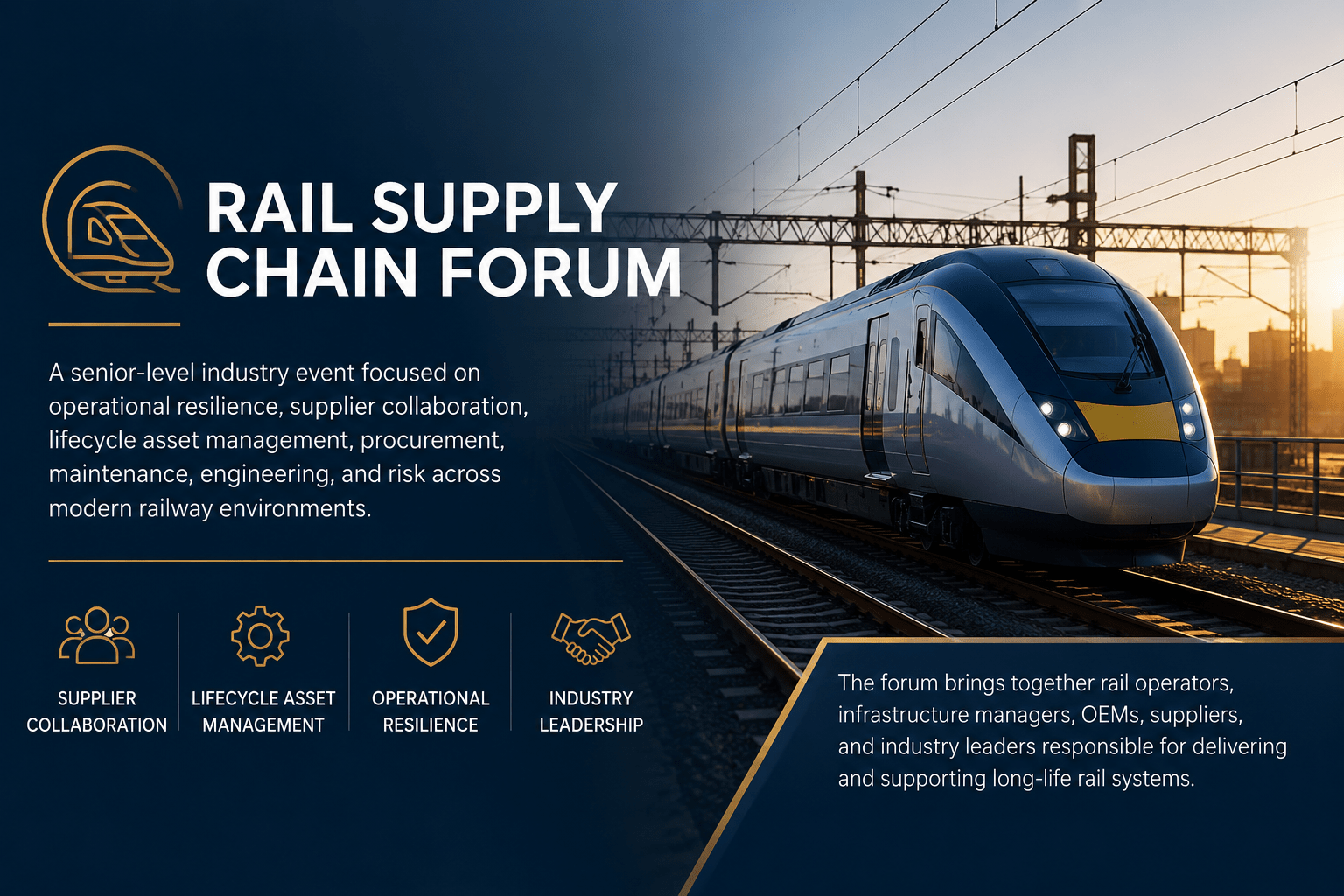
To support these conversations, we are launching the Rail Supply Chain Forum, taking place in London on 10 November 2026.
The forum is designed for senior leaders responsible for operations, engineering, infrastructure, asset management, integration, maintenance, programme delivery, supplier assurance, and risk.
The focus is not on theory.
The focus is on the practical realities of operating railways through increasingly complex supplier ecosystems.
Introducing the Operational Risk Council
The Rail Supply Chain Forum will be the first event delivered under the Operational Risk Council (ORC).
The Operational Risk Council has been created to bring together leaders responsible for preventing operational and commercial failure across large-scale automated, connected, and long-lifecycle operations.
While the first forum focuses on rail, the challenges of accountability, operational visibility, supplier dependency, resilience, and organisational coordination are shared across many industries.
Learn More
Operational Risk Council
https://operationalriskcouncil.com
Rail Supply Chain Forum
https://operationalriskcouncil.com/railsupplychain